Most Office Professionals Think They Understand How to Use AI for Their Job Better Than the Teams Managing AI
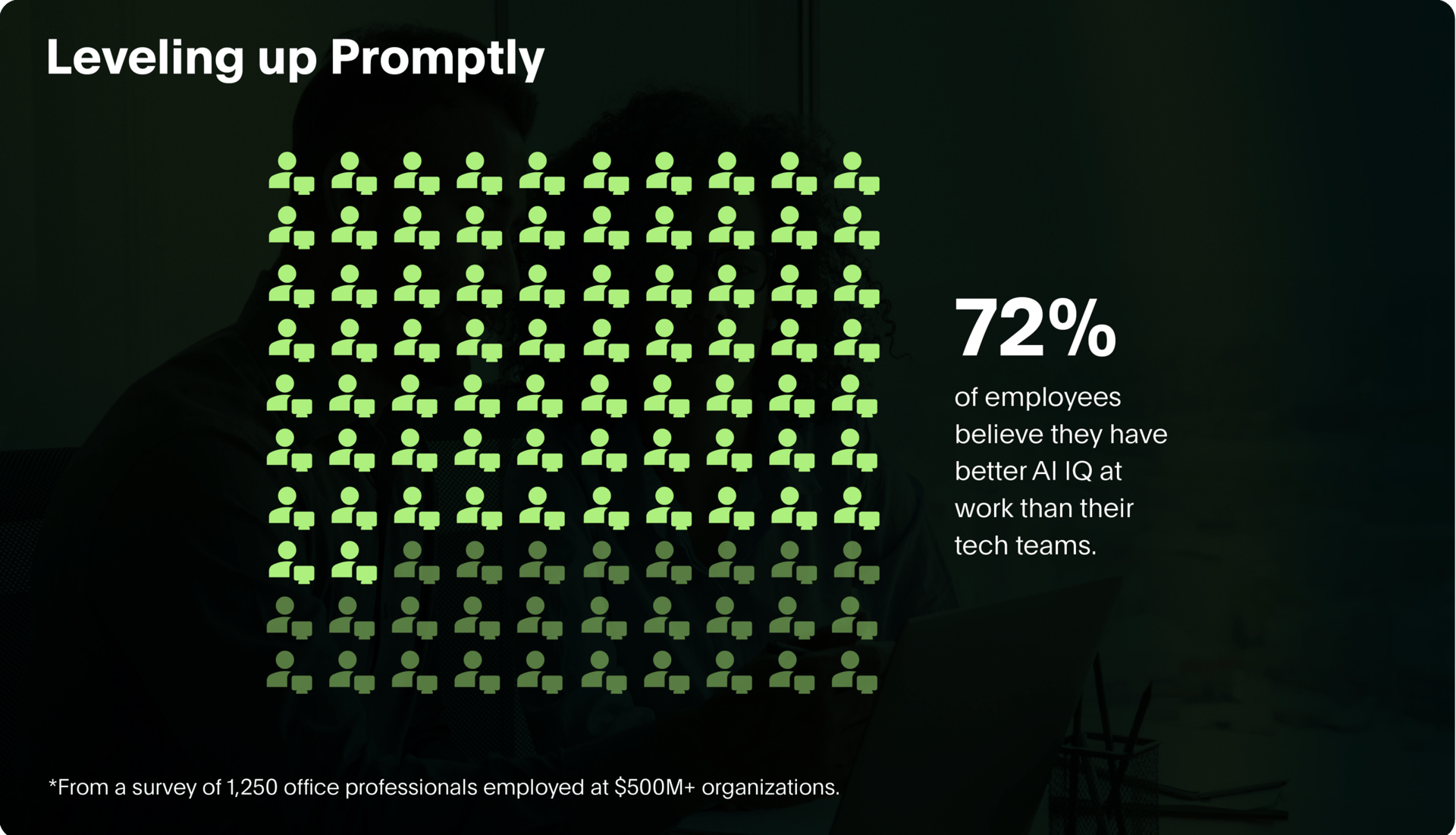
AI use in the office has now become so widespread that non-technical employees are quickly growing more confident in their AI expertise. In fact, a significant majority of office professionals (72%) believe they understand how to use AI for their job better than the team responsible for managing AI at their company, according to a survey of 1,250 office professionals working in non-IT and technology roles at companies with a minimum annual revenue of $500m, conducted by Wakefield Research for PagerDuty.
This sentiment is consistent across the four regions surveyed — Australia, Japan, the United Kingdom, and the United States — and hits a fever pitch at billion-dollar enterprises, where 80% of employees believe they have better AI IQ at work than their tech teams. Senior leaders (77%) are also more likely to feel this way than mid-level managers or below (66%).
Self-Directed. The rise of shadow AI is often a result of vague corporate policies and high levels of managerial trust. A strong majority (87%) believe their company’s leaders trust employees to figure out for themselves which AI tools work best for their day-to-day work. In the United Kingdom, that number jumps to 94%. Those who regularly use AI as part of their work responsibilities are more likely (47%) to experience a great deal of trust from leaders to find their own way than those who only use AI occasionally or less often for work (20%).
Crossing Over. The penetration of popular AI tools such as ChatGPT, Claude, and Gemini into everyday life is becoming evident at the office as more workers show up to work with bootstrapped AI skills. Among workers who’ve used AI in their work responsibilities, 89% first used an AI tool at work, after using it in their personal life. In the U.K., 69% are more likely to have done this multiple times, compared to 60% globally. Those who use AI regularly as part of their work are much more likely (67%) to have adopted AI tools multiple times after using them personally than those who only use AI at work occasionally or less often (47%). Regardless of how it began, those using AI for work find themselves using AI more often on the job (79%) than outside of work (21%).
At Home with AI. While regular AI use – multiple times a week – seems to happen more often at home (63%) than at work (46%), a larger majority (79%) are occasionally using AI in their personal lives. Senior leaders are sold: they’re much more likely (90%) than mid-level managers or below (64%) to try AI some of the time. Top use cases for personal use include research and learning (43%), planning and organizing schedules (40%), writing or creating other content (36%) and for advice and guidance on issues or to help with logistics (both 33%).
Bring Your AI To Work Day. Those who have adopted AI tools at work (after using them first in their personal life) have some clear motivations for doing so. For 45%, it’s because they saw clear ways that AI tools could help them be more efficient at work. Others brought AI to work because of a change, such as AI becoming more widely accepted in their workplace (43%), a role or responsibility change that made AI relevant to them (40%), or their organization formally approving or introducing AI tools (40%). Overall, 63% are regularly using AI as part of their work responsibilities globally.
Breaking AI Policies. Among those who have ever used AI as part of their work responsibilities, two-thirds (66%) have used AI tools or services at work even though they believed they were not allowed under company policies. This is more common at larger companies with 1,500 employees or more (72%) than at those with fewer employees (60%). As a result of that unauthorized AI use, more than half (53%) received informal feedback or guidance, while 48% faced formal consequences, such as a warning or disciplinary action. In Japan, workers were much more likely to experience disapproval from coworkers (47%) than globally, where 28% went through this.
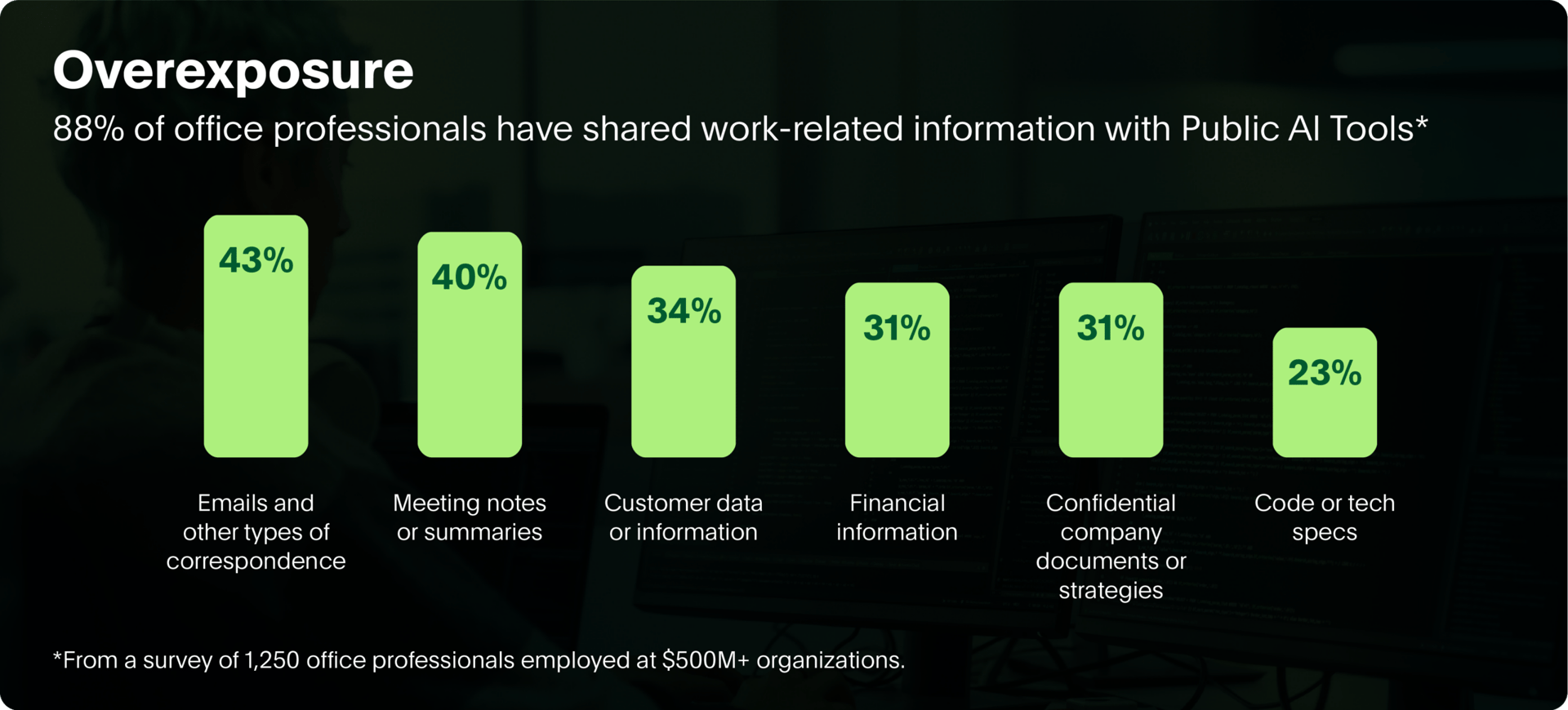
AI Confidential. Rising employee confidence in AI is becoming a major liability for companies, as workers increasingly feed sensitive internal data into public models. More than two in five (43%) have entered emails or other work-related correspondence into public AI tools such as ChatGPT, Claude, or Gemini that aren’t part of their company’s internal systems. In the U.K. and Japan, that rises to 51% and 50%, respectively. Even more troubling, more than a third (34%) have entered customer data or information into public AI tools, while 31% have input financial information or disclosed confidential company documents or strategies. Those at smaller companies with fewer than 1,500 employees are more prone to enter customer data or information into public AI tools (40%) than those at larger companies (27%).
Rules Disparities. One reason that workers may think they’re justified in their AI use, whether it’s allowed or not, is that they view the policies at their company as inconsistent. While the vast majority (86%) work at companies where they believe there are policies for AI tools, more than four-fifths (81%) believe there are different rules, or treatment of rules, around AI policies for leadership than the rest of the company. Those at larger companies, either by revenue or headcount (85% for both) are more likely to feel this way, as are mid-level managers and below (85%) compared to senior leaders (78%).
Hiding in Plain Sight. A third of those who have used AI for their work responsibilities would hide their AI use to dodge judgement from their superiors. Avoiding scrutiny from managers or leadership is one of the top reasons (33%) that AI-using workers would intentionally hide or keep from disclosing using AI for their job. Another 30% would hide it because their company policies are restrictive or to avoid judgment from coworkers. Some (29%) are unsure if their AI use is allowed or not. But a similar share (29%) claim they wouldn’t hide or avoid disclosing their AI use at all.
Risking No. Even with so many workers engaging in shadow AI, there are still many who want to follow the rules, or at least have some guidance on what is allowed. Only 39% would rather use AI for work without telling anyone rather than risk being told they cannot use it. However, at larger companies with $1 billion or more in revenue (47%) and at companies with 1,500 or more employees (46%), there’s more likelihood of that. Senior leaders (46%) are also more likely to want to beg forgiveness later than ask for permission up front, as are those who would consider seeking another job that offered better AI skills development (44%).
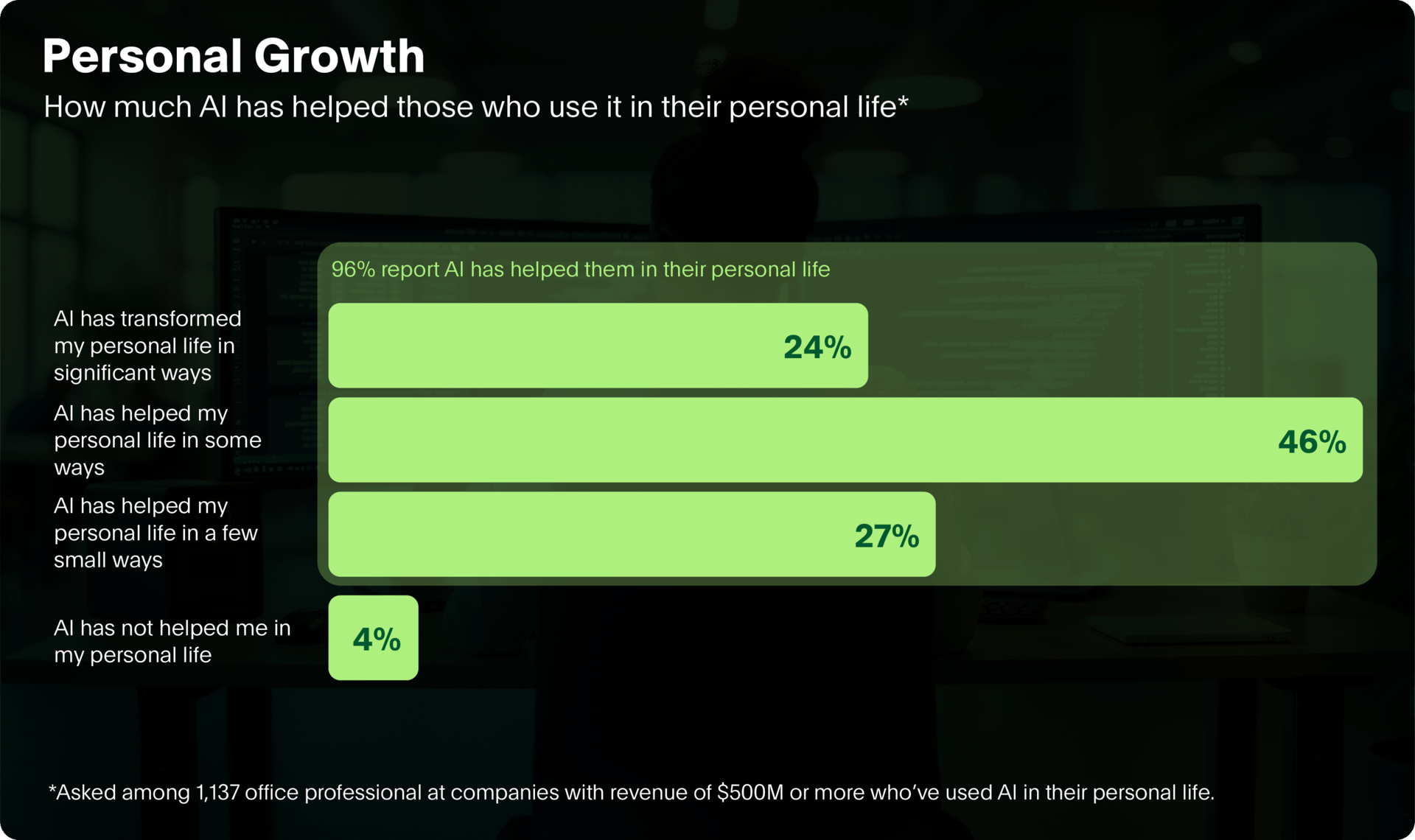
Life, Hacked. Outside of work, nearly all who have used AI in their personal life are almost universally willing (96%) to give the tech credit for helping them in at least a few small ways. But some (24%) go so far as to call it transformational, changing their life in significant ways. In the U.S., that’s even more likely (29%), as it is among senior leaders (29%) compared to mid-level managers and below (15%).
AI’s Shift. Our coexistence with AI is evolving rapidly and as more people are tasked with using it at work, their habits and reliance on the tech are shifting. Half (50%) have used personal devices to complete work tasks or projects with AI while 45% have gone to AI for work-related advice or help making decisions. Notably, 44% have used AI to work around limitations with existing company-approved tools. Nearly two out of five (38%) have shared AI-assisted work without disclosing that artificial intelligence helped.
METHODOLOGICAL NOTES
The PagerDuty Shadow AI Survey was conducted by Wakefield Research among 1,250 office professionals working at companies with a minimum annual revenue of $500m, excluding IT and technology roles in four markets: Australia, Japan, U.K. and U.S., quotas were set for 500 respondents in the U.S., and 250 in each remaining market, between April 9th and April 20th, 2026, using an email invitation and an online survey.
Results of any sample are subject to sampling variation. The magnitude of the variation is measurable and is affected by the number of interviews and the level of the percentages expressing the results. For the total interviews conducted in this particular study, the chances are 95 in 100 that a survey result does not vary, plus or minus, by more than 2.8 percentage points, the result that would be obtained if interviews had been conducted with all persons in the universe represented by the sample; and 4.4% for the US, and 6.2% for the other markets.
Full report can be downloaded here