- PagerDuty /
- Blog /
- Announcements /
- Automate Service Mapping at Scale with PagerDuty and Spotify for Backstage
Blog
Automate Service Mapping at Scale with PagerDuty and Spotify for Backstage
by Aatharsha Jeyachelvan
June 3, 2026
| 5 min read
This blog post is part of PagerDuty’s ongoing series on how we’re helping customers navigate their journey towards autonomous operations. Read on to learn about how Service Mapping for PagerDuty’s plugin for both Spotify for Backstage and Spotify Portal for Backstage, now generally available, builds towards this vision.
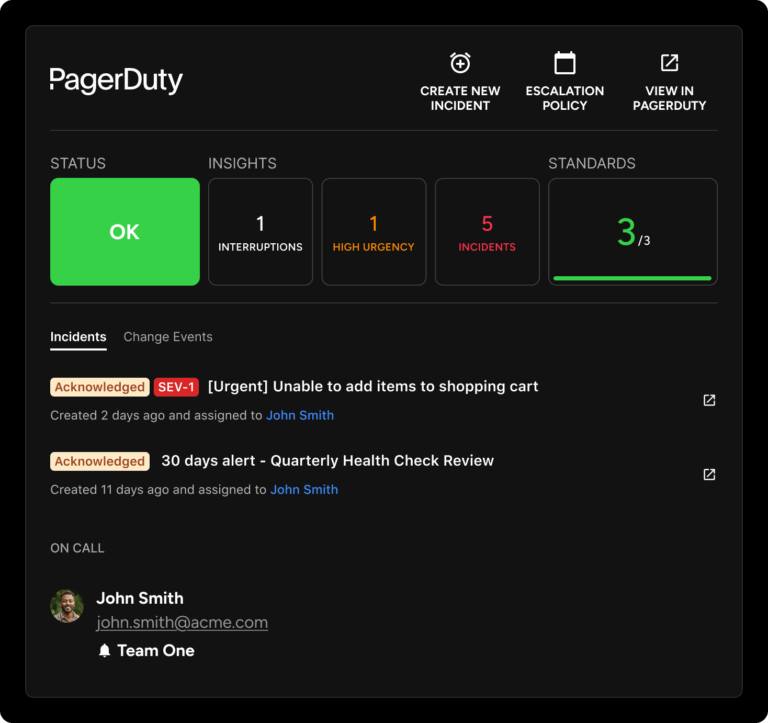
Last October, we announced PagerDuty’s integration with Spotify Portal for Backstage; a milestone in our commitment to continue meeting developers where they work. Since then, we have continued to evolve our partnership with Spotify to deliver even more capabilities to our customers. By combining service knowledge from Spotify for Backstage or Spotify Portal for Backstage, with PagerDuty’s incident management expertise, we give organizations the foundation to move from reactive firefighting to proactive prevention — all within the environments developers use every day. Surfacing the right context at the right time means teams can identify and resolve problems earlier in the development lifecycle, maintaining deployment velocity without sacrificing reliability, security, or compliance.
The hidden cost of manual service mapping
For engineering organizations running hundreds or thousands of services, the promise of a unified developer portal is only as good as the data inside it. This is because they face a painful, manual process to map services to Backstage components. The result? Stalled plugin adoption, lost operational context and a Backstage investment that never reaches its full potential.
The root cause isn’t effort, it’s tooling. Platforms evolve independently, naming conventions drift, and there’s no shared source of truth to bridge the gap. What organizations need isn’t more manual processes; they need automation that can close the gap and surface the rest for rapid human review.
Announcing automated service mapping for PagerDuty’s Plugin for Backstage
PagerDuty is introducing service mapping for both of its plugins for Spotify for Backstage and Spotify for Portal, now generally available, bringing enhanced automation to one of the most time-consuming parts of the integration setup. The release brings three key capabilities that allow teams to automate their component-to-service connections with an intelligent matching algorithm for a bulk review and acceptance workflow, yielding high-confidence matches.
- Automatically connect PagerDuty services to Backstage components
Mapping services manually means someone has to know both platforms well enough to reconcile them — and then do it repeatedly as services change. For large organizations, that’s not a one-time project; it’s ongoing overhead that compounds with every new service, team, or rename.
The intelligent matching algorithm analyzes service name similarity and team associations across both PagerDuty and Backstage, normalizing naming conventions so that differences in casing, punctuation, or phrasing don’t block a match. The algorithm automatically identifies exact matches and classifies near-matches by confidence level. Initial internal testing shows it resolving exact matches for 20% of services automatically and identifying high-confidence matches (80%+) for nearly half of services, dramatically reducing the scope of manual work required. 1
- Review and accept high-confidence matches in bulk
Even when an algorithm is confident, humans should stay in the loop. Especially for service ownership decisions that affect incident routing. The challenge is making that review fast enough that it doesn’t become its own bottleneck.
A dialog-based bulk review workflow surfaces all high-confidence matches in a single interface, allowing teams to review and accept connections in one pass rather than service by service. Matches are presented with confidence scores so reviewers can make informed decisions quickly. The result is a workflow that keeps humans in control without requiring them to do the work the algorithm can handle.
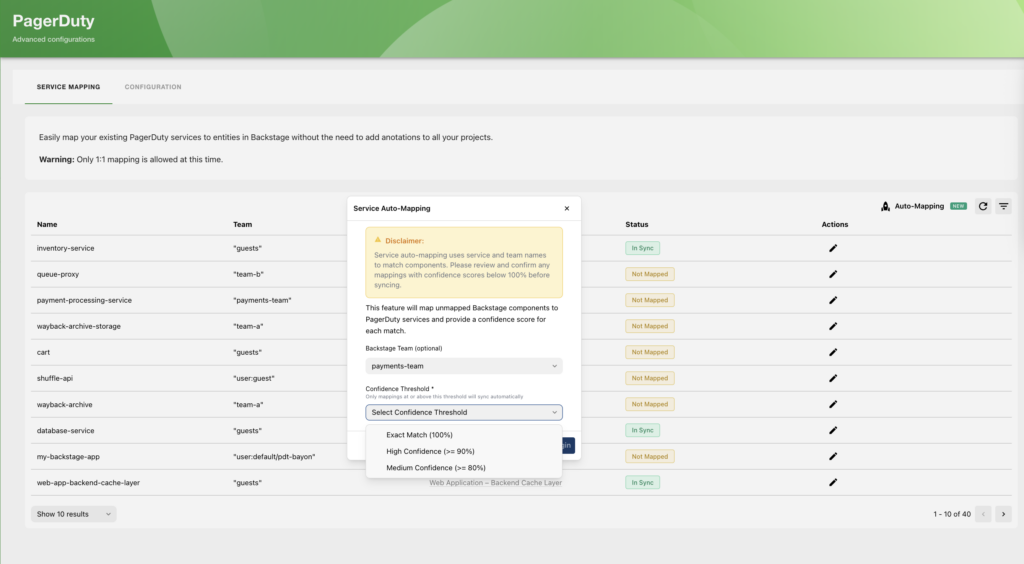
- Map remaining services with enhanced search and sorting
For services that fall below the confidence threshold, or where organizational context matters more than name similarity, manual mapping remains available but is significantly faster than before.
The enhanced dropdown interface includes intelligent sorting and search capabilities, making it easy to locate the right Backstage component without scrolling through an unsorted list. Search works across service names, and sorting prioritizes the most likely candidates so even manual mapping takes seconds rather than minutes per service.
Bringing it together
These three capabilities work as a system. The algorithm handles the bulk of the work automatically. The bulk review workflow processes the high-confidence remainder efficiently. The enhanced manual controls clean up the edge cases. Together, they turn a multi-hour configuration project into a task that can be completed in a single session to keep the integration accurate as the service catalog evolves.
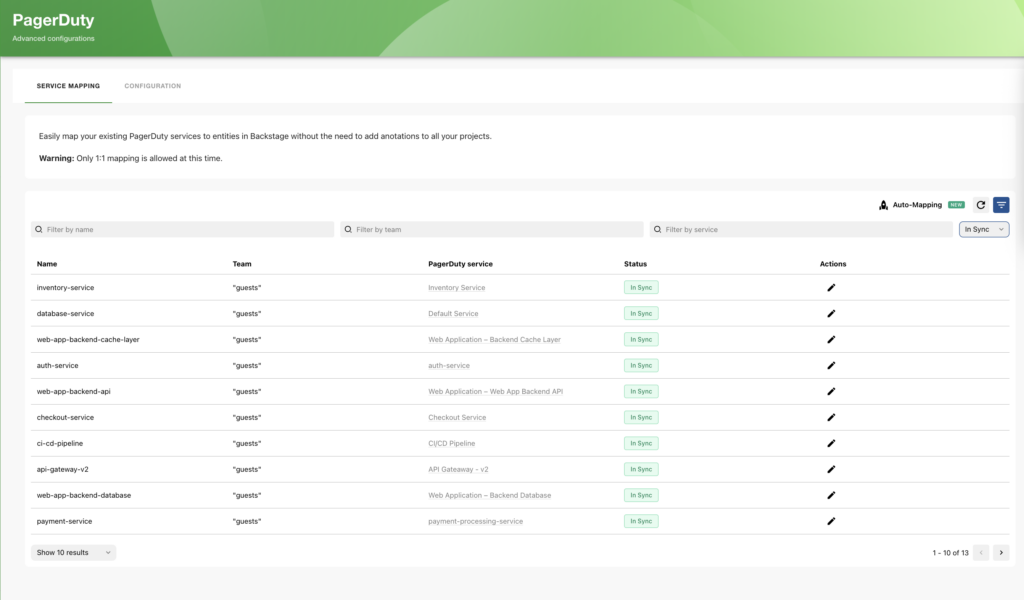
Paving the path to autonomous operations
Your team shouldn’t have to spend hours on configuration that prevents your tools from working together. A complete service catalog isn’t just an operational nice-to-have; it’s the foundation for everything else the plugin delivers, achieved by removing the friction that prevents teams from getting full value from the tools they’ve already invested in. When every service is mapped, every incident feeds the flywheel. The context captured is stored in operational memory and fed back into the platform, so the next incident is resolved faster. A complete, accurate integration with Spotify for Backstage and Spotify Portal for Backstage, means better service context during incidents, faster triage, and a developer portal that actually reflects how your organization operates. This is how PagerDuty is continuing to deliver on its approach to autonomous operations: turning today’s incidents into tomorrow’s prevention through data at scale, intelligent automation, and a flywheel effect that makes your operations smarter over time.
Service Mapping for PagerDuty’s plugin for Spotify for Backstage and Spotify Portal for Backstage moves us closer to that vision. Ready to see how it can accelerate your Backstage integration and put full-service context to work for your team?
Learn more at https://www.pagerduty.com/integrations/backstage/, read our knowledge base, or connect with your PagerDuty account team.
_______________________________________
1Match rate may vary depending on customer’s service data. Results are based on a representative sample of accounts.