- PagerDuty /
- Blog /
- Gestion et réponse aux incidents /
- Activez votre cercle vertueux d'apprentissage continu grâce aux revues post-incident dans l'interface utilisateur de PagerDuty.
Blog
Activez votre cercle vertueux d'apprentissage continu grâce aux revues post-incident dans l'interface utilisateur de PagerDuty.
par Cristina Dias
6 mai 2026 | 9 min de lecture
[Modifié le 1er juin 2026 avec les dernières mises à jour]
Plus tôt cette année, dans notre Lancement prévu au premier semestre 2026 Nous avons dévoilé la vision de PagerDuty pour les opérations autonomes : un avenir où les agents d'IA tirent des enseignements de chaque incident, préviennent les défaillances et automatisent progressivement les processus afin que les équipes puissent se concentrer sur l'innovation plutôt que sur la gestion des urgences. Chez PagerDuty, nous adoptons une approche systématique : chaque incident devient une source d'information précieuse pour l'organisation, qui alimente vos opérations et rend vos systèmes plus intelligents et plus résilients au fil du temps.
Depuis des années, nous sommes des leaders d'opinion en matière d'analyses post-incident constructives et de « Fail Fridays » grâce à notre fonctionnalité d'analyse post-incident et à l'acquisition de Jeli. Nous avons beaucoup appris de nos clients et nous faisons évoluer l'expérience post-incident pour vous aider à rompre le cycle des incidents répétés, à gagner du temps et à bâtir des opérations plus résilientes. Aujourd'hui, nous franchissons une nouvelle étape avec les revues post-incident dans l'interface utilisateur de PagerDuty , actuellement déployées. Accès anticipé .
Vos enseignements tirés des incidents se perdent-ils dans le chaos ?
Vous savez que tirer des leçons des incidents est le seul moyen d'améliorer la résilience sur le long terme. Pourtant, nous constatons souvent que nos clients ont des difficultés à mener à bien leurs missions et à assurer le suivi. Les analyses post-incident (API) sont négligées, les actions correctives ne sont pas réalisées et les mêmes incidents se reproduisent. Votre équipe s'épuise et vous êtes bloqué dans une gestion réactive des incidents.
- Le changement de contexte entraîne une perte de détails. Les équipes jonglent entre les outils de surveillance, Slack, les systèmes de gestion des tickets et les plateformes de documentation. Résultat : au moment où quelqu’un rédige le rapport d’incident, le contexte essentiel a disparu.
- Le travail manuel prend trop de temps. Rédiger des critiques complètes à partir de zéro prend des heures que les rédacteurs épuisés n'ont pas.
- Les informations restent cloisonnées. Même les rapports d'incidents post-incident (PIR) complétés sont rarement intégrés aux systèmes qui pourraient prévenir de futurs incidents.
Le résultat ? Des incidents à répétition et des occasions manquées de mettre en place des opérations plus résilientes.
Les nouvelles revues post-incident, directement disponibles dans l'interface utilisateur de PagerDuty , résolvent ce problème en intégrant l'intégralité du flux de travail PIR directement dans l'expérience d'incident.
Capturez les enseignements sans quitter PagerDuty
Examens post-incident Elles sont intégrées directement à l'expérience de gestion des incidents dans l'interface utilisateur de PagerDuty . Lorsqu'un incident est résolu par votre équipe, que ce soit via Slack ou l'interface web, une revue post-incident peut être lancée immédiatement depuis PagerDuty, avec le contexte complet de l'incident déjà accessible.
Ce que vous obtenez :
- Commencez les PIR depuis votre lieu de travail. Lancez une revue directement depuis Slack après la résolution d'un incident (bientôt disponible), ou depuis la page de détails de l'incident dans l'interface web. Aucun outil ni identifiant supplémentaire n'est requis. Les rapports d'incident sont créés automatiquement à la résolution d'un incident ; votre équipe n'a donc plus à s'en soucier.
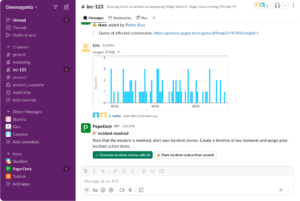
- Tout le contexte au même endroit. Chaque rapport d'incident (PIR) inclut la chronologie complète de l'incident, les actions des intervenants, les informations de service et les données d'alerte. PagerDuty importe automatiquement le contexte des conversations Slack, des résumés de Scribe Agent et des événements du cycle de vie des incidents (ILE). Ainsi, toutes les informations documentées dans ces sources sont déjà présentes dans le PIR. Par conséquent, pour générer un PIR initial, il n'est plus nécessaire de parcourir les canaux Slack, d'examiner les journaux ou de se souvenir des actions de chacun. L'historique et le contexte de l'incident sont immédiatement disponibles à l'ouverture du PIR.
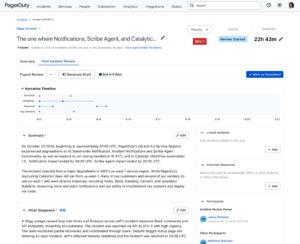
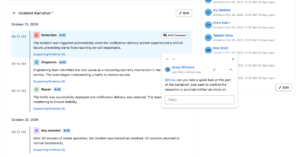
- Collaboration en temps réel. Plusieurs membres d'une équipe peuvent collaborer simultanément sur une même analyse, grâce à des curseurs en temps réel indiquant qui modifie quoi. Fini les conflits de versions et les modifications perdues : chacun peut voir les changements en direct. Que vous soyez le responsable de l'incident ajoutant la chronologie, un ingénieur documentant la cause racine ou un gestionnaire évaluant l'impact, chacun peut contribuer simultanément sans interférer avec le travail des autres.
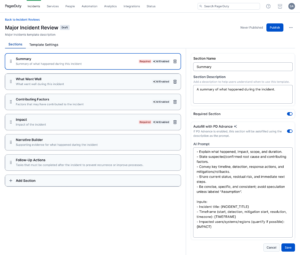
- Modèles structurés. Guidez votre équipe grâce à des analyses cohérentes et approfondies, grâce à des modèles personnalisables qui garantissent qu'aucun élément n'est négligé. Créez des modèles comportant des sections telles que « Que s'est-il passé ? », « Cause profonde », « Impact » et « Leçons apprises » afin d'uniformiser votre processus d'analyse post-incident (API) entre les équipes. Vous pouvez les personnaliser pour répondre aux besoins spécifiques de votre organisation et vous assurer que chaque analyse recueille les informations les plus importantes pour vous.
Au lieu de considérer les analyses post-incident comme une simple formalité, elles deviennent une étape naturelle du traitement de chaque incident. Lorsque les équipes peuvent tirer des enseignements immédiatement et sans difficulté, ces connaissances deviennent le carburant qui alimente des opérations plus intelligentes.
Laissez l'IA faire le gros du travail.
Grâce à la dernière extension de notre programme EA, les analyses post-incident utilisent désormais une IA native pour rédiger automatiquement le contenu de votre rapport d'analyse post-incident, transformant des heures de travail manuel en quelques minutes de perfectionnement.
Voici ce qui est disponible dès maintenant en accès anticipé :
- Brouillons instantanés générés par l'IA. L'IA générera automatiquement le contenu du PIR (résumés, moments clés de la chronologie, causes profondes et suivis suggérés) en fonction du contexte complet de l'incident.
- Données ingérées automatiquement à partir de Slack, de l'agent Scribe et des événements du journal des incidents. Dès le lancement d'une PIR, les données de vos outils connectés seront ingérées et pourront être utilisées pour générer une première ébauche.
- Collaborez via les commentaires et les mentions (@). Vous pourrez identifier les parties prenantes, poser des questions et affiner le récit ensemble. Assurez-vous que les équipes transversales restent alignées sur les événements et les prochaines étapes.
- Créez des suivis concrets grâce à l'assistance de l'IA. Nos actions de suivi suggérées par l'IA contribuent à garantir que les enseignements tirés se traduisent par des améliorations concrètes, en assurant le suivi des responsabilités et des progrès pour boucler la boucle.
Conçu pour votre façon de travailler
Les revues post-incident dans l'interface utilisateur de PagerDuty s'intègrent parfaitement à vos flux de travail existants :
- Expérience native Slack. Démarrez des PIR dans Slack en un clic (bientôt disponible), importez les données des canaux et collaborez.
- Interface utilisateur Web pour une analyse approfondie. Accédez à l'expérience PIR complète dans l'interface web de PagerDuty avec édition de texte enrichi, visualisation chronologique et contexte d'incident précieux.
- Intégration Jira (bientôt disponible). Synchronisez les actions de suivi avec Jira pour suivre les travaux de correction parallèlement à vos flux de travail de développement existants.
- Accès API (bientôt disponible). Accédez par programmation aux données PIR pour créer des intégrations personnalisées, des tableaux de bord analytiques ou pour intégrer des informations dans d'autres systèmes.
- Ajouter des pièces jointes pour une analyse plus approfondie (bientôt disponible). Vous pourrez télécharger des manuels d'exploitation, des captures d'écran, des journaux ou des documents justificatifs pour enrichir vos rapports d'incident.
- Personnalisation des invites de l'IA (bientôt disponible). Vous pourrez créer des modèles spécifiques à chaque compte, avec des invites IA personnalisées et adaptées au format PIR de votre organisation. Indiquez les sections obligatoires et contrôlez la génération IA section par section.
- Intégrez les informations dans la mémoire de l'agent SRE (bientôt disponible). Les enseignements tirés du PIR seront automatiquement réintégrés dans la mémoire de l'agent SRE de PagerDuty , améliorant ainsi la réponse aux incidents futurs et aidant les développeurs à évaluer les risques de déploiement afin de prévenir les incidents avant qu'ils ne surviennent.
Il en résulte un cercle vertueux d'apprentissage continu. Des enseignements complets sont tirés en quelques minutes au lieu de plusieurs heures, et ces informations sont réinjectées dans vos opérations pour les rendre plus résilientes.
Prêt à commencer ?
La fonctionnalité d'analyse post-incident dans l'interface utilisateur de PagerDuty est actuellement déployée en accès anticipé pour les clients disposant des forfaits Incident Management et CSOps Professional et supérieurs.
Inscrivez-vous pour un accès anticipé pour commencer à transformer vos incidents en prévention.
____________________________________________
Safe Harbor
Ce blog contient des déclarations prospectives. Toutes les déclarations autres que celles portant sur des faits historiques, y compris celles relatives aux résultats d'exploitation et à la situation financière futurs, aux produits et services prévus, à la stratégie et aux plans d'affaires, aux objectifs de la direction pour les opérations futures de PagerDuty, Inc. («PagerDuty» ou la « Société »), à la taille du marché et aux perspectives de croissance, à la position concurrentielle et aux tendances technologiques et de marché, sont des déclarations prospectives. Ces déclarations peuvent être identifiées par des termes tels que « s'attendre à », « anticiper », « devoir », « croire », « espérer », « viser », « projeter », « objectifs », « estimer », « potentiel », « prédire », « pouvoir », « vouloir », « avoir l'intention de », « devoir », ou leur forme négative, ou encore par d'autres expressions similaires. Il convient de ne pas se fier à ces déclarations prospectives comme à des prédictions d'événements futurs.
Les résultats des événements décrits dans les déclarations prospectives contenues dans ce blog sont soumis à des risques, incertitudes, hypothèses et autres facteurs connus et inconnus qui pourraient faire en sorte que les résultats, performances ou performances réels de PagerDuty diffèrent sensiblement de ceux exprimés ou sous-entendus par ces déclarations prospectives, notamment : l’incidence des incertitudes liées à la pandémie de COVID-19 sur les marchés américains et mondiaux, nos activités, nos opérations, nos résultats d’affaires, nos flux de trésorerie, nos charges d’exploitation, la demande pour nos solutions, nos cycles de vente, la fidélisation de la clientèle et les activités de nos clients ; notre capacité à atteindre et à maintenir une rentabilité future ; notre capacité à attirer de nouveaux clients et à fidéliser nos clients existants tout en leur vendant des fonctionnalités et des services supplémentaires ; notre capacité à maintenir et à gérer notre croissance ; notre dépendance aux revenus provenant d’un seul produit ; notre capacité à être compétitifs sur un marché de plus en plus concurrentiel ; et la conjoncture générale des marchés, la situation politique, économique et commerciale.
Les déclarations prospectives contenues dans ce blog sont également soumises à des risques, incertitudes et facteurs supplémentaires, notamment ceux décrits plus en détail dans les documents déposés par PagerDuty auprès de la Securities and Exchange Commission, y compris son rapport annuel le plus récent sur formulaire 10-K.
Les déclarations prospectives reflètent les convictions et hypothèses de la direction de PagerDuty uniquement à la date de leur publication. PagerDuty ne s'engage pas à mettre à jour les déclarations prospectives contenues dans ce blog pour tenir compte d'événements ou de circonstances postérieurs à la date de publication, ni pour intégrer de nouvelles informations ou la survenance d'événements imprévus, sauf si la loi l'exige.
Ce blog contient également des estimations et autres données statistiques, réalisées par des tiers indépendants et par la Société, relatives à la taille et à la croissance du marché, ainsi qu'à d'autres données sectorielles. Ces données reposent sur un certain nombre d'hypothèses et présentent des limitations ; il convient donc de ne pas leur accorder une importance excessive. La Société n'a pas vérifié de manière indépendante les données statistiques et autres données sectorielles produites par des tiers et présentées dans ce blog et, par conséquent, ne peut en garantir l'exactitude ni l'exhaustivité. De plus, les projections, hypothèses et estimations relatives à ses performances futures et à celles des marchés sur lesquels elle opère sont nécessairement soumises à un degré élevé d'incertitude et de risque, en raison de divers facteurs. Ces facteurs, parmi d'autres, pourraient entraîner des résultats sensiblement différents de ceux exprimés dans les estimations réalisées par les tiers indépendants et par PagerDuty.
Pour plus d'informations concernant PagerDuty, veuillez consulter notre dernier rapport annuel (formulaire 10-K) déposé auprès de la SEC. Par ailleurs, nous sommes soumis aux obligations d'information et de déclaration prévues par la loi de 1934 sur les opérations de bourse (Securities Exchange Act of 1934) et, en conséquence, nous déposons auprès de la SEC des rapports périodiques, des rapports d'actualité, des déclarations de procuration et d'autres documents d'information. Ces documents sont consultables sur le site web de la SEC à l'adresse http://www.sec.gov.
Vous pourriez aussi aimer ces articles...