Today’s IT environments generate millions of events daily, far too many for humans to manage manually. With fragmented monitoring tools and noisy alerts, teams can struggle to detect real issues quickly. This complexity demands a smarter approach. That’s where artificial intelligence can make all the difference.
Key Takeaways:
- AIOps uses AI and machine learning to automate and streamline IT operations.
- AIOps automates incident detection and response, reducing manual work and alert noise.
- DevOps is about delivering software efficiently; AIOps is about automating and improving IT operations.
- Key benefits: faster incident resolution, lower costs, improved team collaboration, and less alert fatigue.
- Main challenges: requires quality data, integration with legacy systems, and initial investment.
What is AIOps?
AIOps, or Artificial Intelligence for IT operations, is the application of AI and machine learning to automate and enhance IT operations. It helps organizations detect issues faster, reduce manual tasks, and expedite response times by analyzing large volumes of data in real-time.
Essentially, AIOps solutions provide similar functionality to existing event management solutions, but add capabilities required for complex, modern environments such as machine learning, flexible data collection and ingestion, end-to-end event-driven automation, and more.
AIOps vs DevOps
AIOps and DevOps are related disciplines, but DevOps uses automation and collaboration to optimize software development. AIOps is often considered an evolution of DevOps, as it uses artificial intelligence and machine learning for IT operations such as incident management and automation.
How does AIOps work?
Artificial intelligence platforms operate across data ingestion, pattern recognition, automation, and continuous learning. This process offers a holistic approach to IT operations, turning complex data into actionable insights.
- Data collection and ingestion: AIOps gathers data from multiple sources, such as server logs, network metrics, and observability platforms. Pulling in this data offers a single pane of glass view into the health of your IT ecosystem. This process supports both structured and unstructured data, offering a comprehensive view of the IT landscape.
- Event correlation and pattern recognition: Machine learning algorithms identify patterns within the data, correlating similar events to uncover potential root causes. This process helps filter out non-essential information and prioritize the most critical alerts that require immediate action. While automation streamlines initial analysis, critical alerts are flagged for human intervention, ensuring that complex decisions and nuanced problem-solving remain in the hands of your team.
- Anomaly detection and predictive analytics: By analyzing historical trends and recognizing unusual patterns, AIOps can detect anomalies that may indicate emerging issues, enabling preemptive actions to prevent downtime.
- Automation and remediation: AIOps platforms automatically execute predefined workflows to resolve issues. For example, in a data center, an AIOps tool might detect high CPU usage and initiate a response to prevent a server overload.
- Continuous learning and feedback: As AIOps software processes data, it continuously learns from each incident, refining its predictive algorithms. This learning enhances accuracy and enables a more efficient response to similar issues in the future.
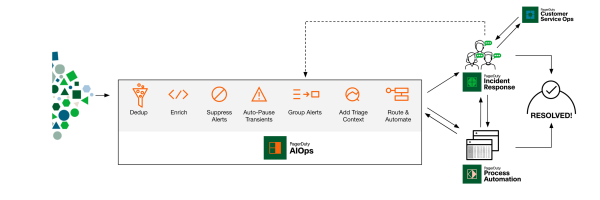
AIOps key capabilities
Some of the key capabilities of AIOps include:
- Noise reduction: Organizations should be able to reduce noise across services and eliminate interruptions caused by transient alerts or alert storms. Alerts should be grouped into relevant incidents instead of kicking off a new incident each time.
- Triage and RCA: AIOps solutions should provide users with the context needed to do their jobs faster. This includes context pulled from event data and normalized, previous historical context, and current system impact.
- Automation: Organizations should be able to create and scale automation across their technological ecosystem, reducing toil and improving efficiency. This should be able to be centrally controlled as well as available self-service for individual teams.
- Visibility: AIOps solutions should be a single pane of glass that shows teams their operating posture at all times, helping to answer the all-important question, “Is my system OK?”.
Benefits of AIOps
AIOps helps modern operations teams cut through the noise, automate the routine, and respond faster.
Here are five key benefits:
- Faster incident resolution: Machine learning surfaces the right context, routes issues to the right teams, and suggests next-best actions—reducing Mean time to acknowledge (MTTA) and Mean time to repair (MTTR). That means fewer disruptions, less lost revenue, and better customer experiences.
- Lower operational costs: By automating repetitive tasks and first-response actions, AIOps frees up time for high-value work and reduces reliance on manual triage and diagnostics.
- Stronger cross-team collaboration: Centralized data and shared insights keep Dev, Ops, SRE, and platform teams aligned, before, during, and after incidents.
- Scalable, always-learning automation: AIOps improves over time. As the system learns from how your team works, it continuously tunes alerting, triage, and response recommendations.
- Healthier teams, happier customers: Less alert fatigue and more efficient workflows prevent burnout. In turn, teams stay focused, productive, and better able to deliver reliable service.
AIOps challenges
Despite its potential, there are some challenges that organizations must address for successful AIOps implementation:
- Data volume and quality: AIOps requires a significant amount of quality data. Low-quality or incomplete data can skew insights, leading to inaccurate incident detection. Organizations must prioritize data governance to ensure accurate, reliable inputs.
- Integration with legacy systems: Older systems may lack the necessary compatibility, hindering data collection and analysis. A phased integration plan helps organizations gradually incorporate AIOps without disrupting legacy operations.
- Scalability concerns: As organizations grow, scaling operations across expanded IT environments can become complex. Planning for scalability from the start, including adequate infrastructure and clear processes, helps mitigate these challenges.
- Cost of implementation: Implementing AIOps requires significant investment in both technology and training. To offset costs, organizations can prioritize high-impact areas initially, gradually scaling their AIOps capabilities.
AIOps enables faster incident resolution, lower costs, and stronger team performance. While implementation has its challenges, the long-term payoff in reliability, efficiency, and customer satisfaction makes it a strategic investment for any modern enterprise. PagerDuty AIOps helps teams achieve fewer incidents and faster resolution with no maintenance required and no lengthy implementations. Start a free trial today.