
The 5 Stages of AI-Human Collaboration to Improve Operational Reliability
by PagerDuty
September 22, 2026
| 7 min read
AI adoption is now a measurable driver of both uptime and growth.
According to PagerDuty’s 2026 State of AI-First Digital Operations report, 75% of organizations actively incorporating AI into digital operations claim to have improved operational resilience and maturity over the past year. The same report suggests AI in operations is also a revenue driver. Among companies with growing revenue, 61% actively use AI in day-to-day digital operations (compared to 55% of companies with flat or declining revenue).
Yet, giving AI agents authority over production infrastructure still feels risky. Headlines about runaway agents, spiraling API costs, and AI systems causing service disruptions on their own have given executives good reason to be cautious.
But deploying AI in operations doesn’t have to be an either-or game. You don’t need to surrender complete backend control to an autonomous system. Most organizations find success in offloading toil-heavy tasks to AI at specific stages of the incident lifecycle, which, in turn, enables teams to engage in higher-value work that actually requires their expertise.
This guide maps how the most resilient organizations plug AI into every stage of the incident lifecycle, making it work side-by-side with humans from detection to response to ongoing learning.
The incident lifecycle: End-to-end view
Every incident moves through five stages: detection, triage, diagnostics, remediation, and learning. AI carries more of the load early on, handling repetitive, pattern-based work like signal correlation and alert routing. Humans hold more of the decision-making later on, where customer communication and accountability demand strategic judgment AI can’t provide.
The map below shows where AI operates at each stage today.
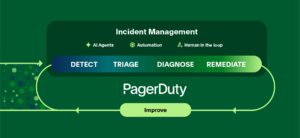
The AI-powered incident lifecycle: five connected stages embedded in one continuous learning system
By bringing each stage of the incident lifecycle into an integrated platform, you give AI agents the data-rich environment they need to keep learning from your operations workflows. That’s how PagerDuty operates: It turns every incident into insight, creating a continuous learning loop where agents and humans get more effective over time. You get operational resilience when something breaks, and prevention so it doesn’t.
Here’s how to apply AI strategically at each stage.
Stage 1: Detection (distilling noise into clear signals)
AI’s job at the detection stage is to turn event noise into clear signals that tell your team what needs attention and what doesn’t, before alert fatigue slows anyone down.
Your telemetry systems generate noise nonstop: metrics, logs, and traces arriving from every layer of your stack. Today, 44% of organizations already use AI to monitor system performance. AI spots anomalies and correlates alerts across disparate sources, turning a wall of noise into actionable signals.
In this setup, engineers set the alert thresholds and define which metrics count as business-critical. They decide what actually matters to your organization. AI then applies those definitions at scale.
PagerDuty reduces alert noise through ML-based correlation. Trained on 16 years of operational data to improve detection accuracy, the platform allows your team to open an incident and work directly from a concentrated signal, so they start triage with clarity.
Stage 2: Triage (coordinating the right people fast)
At the triage stage, AI’s job is to get the right people in the loop quickly: coordinating responders and summarizing context from chat history, system logs, and historical system and incident context. What used to eat up the first few critical minutes of every incident now takes only seconds.
Across industries, incident triage requires the lightest human oversight in the lifecycle. Only 33% of organizations still require a human to review detection and triage decisions.
With AI in the setup, your team only has to handle updating on-call policies and validating the routing logic. Otherwise, your time is now free to focus on the high-stakes decisions and nuanced escalation calls that arise in the next stages.
PagerDuty enhances context-gathering and triage by using historical patterns to route each incident to the correct responder. It also assembles the right people into a shared response channel automatically, so your team starts working the problem together.
Stage 3: Diagnostics (finding the real problem)
Once the right people are actively diagnosing the incident, AI can generate root cause analysis from detection signals to narrow the investigation.
As AI grows more capable, teams are trusting it to automate more of the incident lifecycle. Today, less than half of organizations (43%) still require human coordination for cross-functional incident response. Many are actively hiring or reskilling teams around AI-driven response as well.
At the diagnosis stage, AI shortcuts the process by giving your team a starting hypothesis. Your responders bring in broader operational context and strategically prioritize remediation steps when multiple issues compete for attention.
Paige, PagerDuty’s SRE Agent, runs diagnostics and analyzes past incident resolutions to point responders toward a solution. It also assesses downstream impact across dependent services and matches the current incident against historical patterns to see what’s worked before. And to keep stakeholders updated as the response progresses, Paige makes sure every incident-related conference bridge and chat conversation is captured to generate live, structured status updates.
Stage 4: Remediation (fixing and documenting the issue)
Once an issue is properly diagnosed, AI can run pre-approved remediation steps autonomously.
Today, 49% of organizations use AI to automate remediation and recovery steps.
But not every situation lends itself to fully autonomous remediation. PagerDuty determines AI’s involvement in an incident based on three levels:
- Well-understood: These incidents have clear patterns and established fixes, so AI executes the runbook fully on its own without paging a human.
- Partially understood: Patterns and plausible fixes exist, but the nature of the incident isn’t fully clear. AI surfaces context, automates triage, and suggests root causes and remediations, while a human signs off on the final call.
- Novel: These incidents have little to no established pattern, so a human leads while AI assists with noise reduction, triage, and context gathering.
Built-in governance mechanisms let you configure exactly which actions an agent can execute autonomously and which require human oversight.
In every case, the agent generates rough drafts of both the technical status update your engineers see and the plain-language version you send to customers. But your team keeps final sign-off on what goes out publicly, ensuring your control over the messaging when it matters most.
Stage 5: Learning (closing the learning loop)
AI closes a gap that every organization agrees is critical: post-incident reviews. 100% of respondents in PagerDuty’s State of AI-First Digital Operations report believe the process of learning from incidents needs to be strengthened to improve future processes. Yet, less than half of organizations (48%) currently turn incidents into structured learning.
AI removes the toil from post-incident reviews by assembling a full timeline of the entire response process and generating a structured summary of what happened. It can also identify patterns across incidents and surface recommendations for preventing the next one.
Humans no longer have to spend an afternoon reconstructing an incident from memory. Instead, they can review and validate a pre-assembled analysis and focus more on strategic architectural fixes worth the engineering time.
PagerDuty takes it a step further. By automatically capturing key moments in an incident, it populates a post-incident review in seconds, then retains that context to build operational memory of past incidents. That way, post-incident reviews don’t get logged away and forgotten. Every incident your team resolves feeds back into the system to improve agent response at every stage.
Bring AI into the loop with PagerDuty
AI doesn’t replace your engineers. It changes where they spend their time at each stage of incident response. High-performing organizations leverage both contingents of their workforce deliberately, drawing clear boundaries between what AI executes alone and what requires human intervention.
Low-stakes, repetitive work (like correlating alerts, drafting updates, and assembling incident timelines) moves to AI, freeing teams to focus on high-stakes, context-dependent decisions.
PagerDuty’s governance model encodes those boundaries directly into your system with configurable permissions. With each incident, the platform absorbs and feeds data back to your agents to make them more effective.
For organizations hesitant to deploy AI in operations, that structure allows you to widen the aperture of autonomy incrementally. The more data your system captures, the better your agents execute, allowing your team to build trust in the system and automate more processes.
See how PagerDuty brings AI into every stage of the incident lifecycle while augmenting your team’s expertise. Schedule a demo today.