- PagerDuty /
- Engineering Blog /
- From Incidents to Insight: Closing the Post-Incident Review Gap
Engineering Blog
From Incidents to Insight: Closing the Post-Incident Review Gap
by PagerDuty
June 22, 2026
| 7 min read
Every incident your team resolves contains a lesson. The problem is that without a reliable way to capture it, that lesson has to be relearned the next time the same failure mode surfaces.
Having worked with hundreds of thousands of teams as they’ve progressed toward higher operational maturity, we’ve seen this pattern play out consistently. One practice consistently distinguishes teams that respond effectively from teams that continuously improve: the effective use of Post-Incident Reviews (PIRs).
In this post, we’ll share our perspective on the importance of PIRs, discuss the challenges teams face when making them a standard part of their SRE workflows, and introduce our new AI-generated PIR experience. Designed around the lessons we’ve learned from observing high-performing teams, this new experience helps remove common barriers to effective PIR adoption and enables organizations to achieve operational excellence faster.
Why Teams Struggle to Complete PIRs
Think about it: when you’re paged in the middle of the night for a customer-impacting issue, your priority is restoring service, not documenting what happened. By the time the incident is resolved, collecting and organizing all the information needed for a polished post-incident review is rarely the most urgent task on your list. It can wait until the morning, or so you tell yourself. But another priority, or another incident, often arrives before you get back to it. Before long, the PIR never gets written.
This is an extremely common scenario, and the reasons for it are understandable. The challenge isn’t that teams don’t recognize the value of Post-Incident Reviews. It’s that incidents leave behind a trail of information scattered across multiple systems and communication channels.
While responding, your on-call engineer touched half a dozen systems: previous incidents, Slack threads, stakeholder updates, runbooks, log analysis, a bridge call with three other teams. Each one added context. None of it landed in one place.
Stitching all of those pieces together into a meaningful PIR takes time and effort. As a result, one of the most valuable opportunities for organizational learning is often lost in the noise.
PIRs Matter More Than They Seem
Post-Incident Reviews are often treated as a documentation exercise, but that misses their real value.
PIRs are not the goal. The reflection they enable is.
When teams evaluate what went wrong, what impact it caused, what triggered the issue, and how it was resolved, they gain the understanding needed to improve their systems. Those lessons can then be incorporated into engineering and operational practices, making services more resilient and reducing the likelihood of similar incidents recurring.
Over time, this creates a positive cycle. Teams reflect on incidents, knowledge is captured, improvements are made, and customer-impacting incidents gradually decrease.
The benefits extend beyond long-term reliability improvements. The knowledge captured in PIRs remains available to on-call engineers responding to future incidents, often providing context or workarounds that help them resolve issues faster. This knowledge is also made available to the PagerDuty SRE agent, helping it triage incidents and guide response efforts more effectively over time.
In the long term, teams that consistently use PIRs spend less time reacting to fire drills and more time improving systems, reducing risk, and delivering value.
Introducing our new Post-Incident Review Experience
If PIRs are so critical to building reliable systems, the question is why they are still so difficult to consistently produce. The answer is not lack of intent. It is the overhead required to turn fragmented incident context into a coherent narrative. That is what we set out to change.
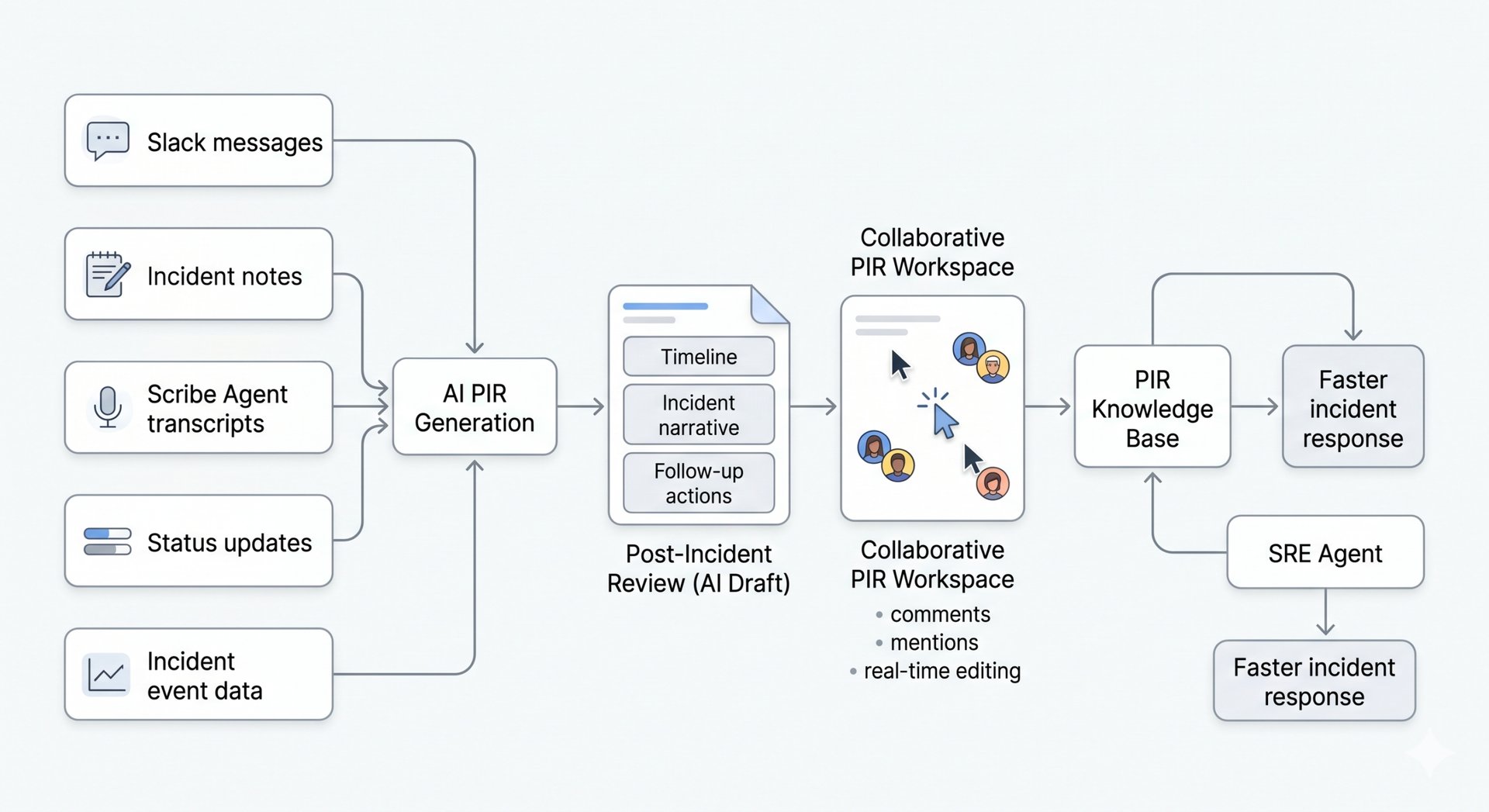
When you close the incident, PagerDuty has already been watching: the Slack thread, the Scribe transcript, the timeline of alerts and escalations. The AI-generated draft surfaces when you need it, built from context that was captured while you were too busy to capture it yourself.
This removes the most time-consuming part of the process: collecting and stitching together information across systems. Engineers can focus instead on refining insights, validating accuracy, and adding the human context that turns a draft into a meaningful learning artifact.
But generation is only part of the experience.
We are also introducing a new collaborative PIR workflow designed to make reviews easier to complete as a team. PIRs now live in a single document-style interface where teams can comment, mention teammates, and collaborate in real time with live cursors and edits. Comments stay anchored to the content they belong to as well as a global view. A Responder can flag in a section, a service owner can question a contributing factor, a follow-up owner can add detail directly alongside an action item. This makes it much easier to capture context from everyone involved in the incident while it is still fresh.
Teams can also attach supporting artifacts directly to the PIR – runbooks, graphs, alert screenshots, architecture diagrams, etc so the PIR becomes a reference document future responders can actually use, not just a written account.
Together, these improvements turn PIRs from a manual, fragmented exercise into a continuous part of the incident lifecycle. And as PIRs become easier to create and maintain, the learning they capture can flow more reliably back into the system, improving tools like the SRE Agent and helping resolve future incidents faster and more consistently.
Closing the Loop on Operational Learning
At its core, our new PIR experience is about closing the loop between incident response and long-term reliability.
Most organizations already have the raw ingredients for learning. Incidents generate rich context, decisions are made in real time, and engineers walk away with a clear understanding of what went wrong. The challenge has always been capturing that understanding in a consistent, usable form, and ensuring it feeds back into how systems evolve.
By reducing the friction of creating Post-Incident Reviews and making it easier to collaborate on them, we help teams preserve that knowledge at the moment it is created. And by connecting PIRs back into the broader PagerDuty ecosystem, that knowledge does not just sit in a document. It actively improves how future incidents are detected, triaged, and resolved.
That is the loop this release closes.
What’s Next
This is only the foundation. In the coming months, we will deepen these capabilities with native integrations for Jira and Slack, customized templates, dynamic prompting alongside enhanced audit logging and version history for greater traceability. By tightening the connection between every incident and PagerDuty’s intelligence layer, we are ensuring that organizational learning is not just captured, but remains actionable, discoverable, and central to how modern systems are built and operated.
About the authors:

Everaldo Aguiar is a Director of Applied AI at PagerDuty, where he leads the Data Science Core and Machine Learning Engineering teams. With a background in predictive analytics and AI, his work focuses on deploying machine learning and Generative AI to enhance automation, noise reduction, and operational efficiency. Everaldo holds a PhD in Computer Science from the University of Notre Dame, where he specialized in education data.

Ishita Roy Chowdhury is a Software Engineering Manager at PagerDuty, where she leads the Incident Analysis team, currently focused on the Post-Incident Reviews product. Her background spans software engineering, digital security, and recommendation systems.