- PagerDuty /
- Blog /
- Announcements /
- Meeting Developers Where They Work: PagerDuty + Spotify Portal for Backstage
Blog
Meeting Developers Where They Work: PagerDuty + Spotify Portal for Backstage
by Shawn Haywood
October 22, 2025
| 4 min read
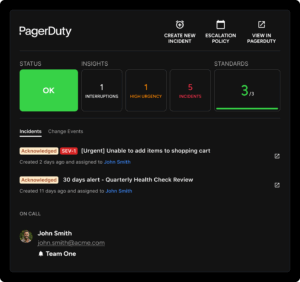
From the beginning, PagerDuty has been built by developers, for developers. Our mission has always been to help development teams build faster and resolve incidents more efficiently by meeting them where they work. Building on PagerDuty’s existing plugin for Spotify for Backstage, we are thrilled to announce the PagerDuty plugin for Spotify Portal for Backstage to continue bringing enterprise-grade incident management into even more developer workflows.
As the first incident management platform to develop a plugin specifically for Spotify Portal, we’re committed to serving our customers at the bleeding edge of developer experience. Now developers can now triage, escalate, and resolve incidents without leaving their Spotify developer portal, eliminating context switching and keeping teams focused on what matters most.
Why developer portals need operations built in
With the rise of platform engineering and the proliferation of microservices, internal developer portals (IDPs) like Spotify Portal have become essential. Gartner predicts that by 2026, 80% of software engineering organizations will establish platform teams as internal providers of reusable services, components, and tools. IDPs are a core enabler of this shift because they centralize documentation, service catalogs, automation, and infrastructure access, helping to reduce cognitive load and speed up delivery. Even as much of the developer workflow is consolidated in IDPs, fragmentation still exists when critical operational intelligence lives outside the developer portal, forcing developers to context-switch across tools during critical moments.
That’s exactly what we are solving with this partnership. By bringing together Spotify Portal’s service knowledge with PagerDuty’s incident management expertise, we enable organizations to evolve from fixing problems to preventing them–all within environments developers already use every day.
This isn’t about adding another tool to the stack; it’s about embedding operational intelligence into development workflows. By surfacing the right context at the right time, teams can identify and resolve problems earlier in the development lifecycle, maintaining deployment velocity while helping to ensure security and compliance requirements can be met.
“Our 360 degree partnership with PagerDuty has been instrumental in the development of this plugin for Backstage and Spotify Portal for Backstage as PagerDuty is both an integration partner and early access customer. The PagerDuty plugin fundamentally helps organizations shift from reactive to proactive issue prevention, evolving developer value.” – Blair Fraser, Partnerships Lead, Spotify
Solving operational challenges with PagerDuty + Spotify Portal
This integration between PagerDuty and Spotify Portal delivers three essential benefits that directly reduce operational friction and improve incident response outcomes:
1) Enhance the developer experience
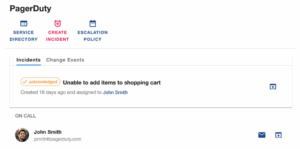
Managing multiple operational tools forces developers to constantly switch between disconnected systems, increasing cognitive load and slowing down work. By embedding PagerDuty directly into Spotify Portal, teams can consolidate alerting, escalation, on-call scheduling, and incident response into a single operational interface.
This unified approach eliminates the tool-hopping that fragments developer focus during critical triage and remediation moments. The result is a consistent, centralized perspective across all teams that reduces cognitive overhead and keeps everyone aligned.
With API and CLI interfaces available, teams can customize and seamlessly integrate this golden path monitoring approach, creating a truly unified operational experience.
2) Accelerate developer velocity
Developers can waste precious time on operational overhead instead of building features that drive business value. Knowledge silos and restricted access force them to queue behind platform teams for basic tasks, while manual incident response processes drag on, creating cascading delays that stall feature releases and slow overall team velocity.
The PagerDuty plugin for Spotify Portal for Backstage changes this dynamic by meeting developers where they already work. With end-to-end incident management capabilities, including timely alerting, defined escalation policies, and robust response coordination, all embedded in Spotify Portal, developers can respond faster and eliminate the bottlenecks that traditionally slow down feature delivery.
Leveraging PagerDuty (with its over 700 integrations), the plugin provides rich contextual information that can help accelerate incident response times, while upcoming custom fields will help ensure developers have exactly the right context to close out incidents quickly and efficiently.
3) Enhance operational excellence
Fragmented data across siloed systems creates inconsistent incident management, operational blind spots, and compliance risks. The PagerDuty plugin for Spotify Portal standardizes incident management by consolidating data and establishing consistent workflows from a single system of record.
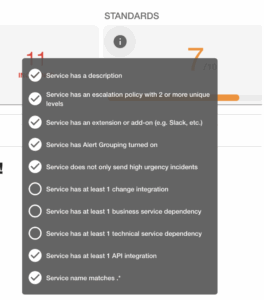
Teams gain comprehensive visibility into system health and can monitor service standards compliance directly within Spotify Portal, enabling proactive risk management that catches issues before they escalate into outages.
With PagerDuty and its over 700 integrations aggregating contextual data, teams receive actionable signals to detect and mitigate issues proactively, improving collaboration and compliance across all development workflows.
Getting started
Ready to get started? To begin setting up the integration, follow the step-by-step instructions in the PagerDuty plugin for Backstage Integration Guide.
Learn more
Want to learn more? Join us for a joint webinar with Spotify on December 17. Sign up today.