- PagerDuty /
- Blog /
- Social Impact /
- How Watch Duty Scales Public Safety and Resilience with PagerDuty
Blog
How Watch Duty Scales Public Safety and Resilience with PagerDuty
by Taymar Quezada
July 13, 2026
| 7 min read
Watch Duty’s Emergency Response Platform Delivers Life-Saving Information and Alerts
When a wildfire ignites, every second counts—yet official emergency alerts often arrive too late for communities in the line of fire. Watch Duty was founded in 2021 to bridge this critical gap in disaster communications. By aggregating and synthesizing data from wildfire cameras, emergency radio traffic, first responders, and official updates, the platform provides real-time, actionable intelligence directly to the public.
As climate-driven disasters intensify across the United States, communities increasingly rely on real-time digital platforms for life-saving emergency information. Watch Duty has emerged as one of the most trusted wildfire intelligence platforms in the United States, serving more than 16 million annual users and delivering critical alerts during rapidly evolving emergencies. The organization’s operational mandate is straightforward but technically demanding: deliver accurate, ongoing, real-time wildfire and flood event intelligence and resources when it’s needed most.
To maintain absolute reliability during periods of extreme traffic and high incident activity, Watch Duty utilizes the PagerDuty Operations Cloud as the foundation of its digital uptime and on-call operations. PagerDuty was selected as the dedicated incident management platform capable of orchestrating both Watch Duty’s digital infrastructure and human network under extreme conditions to ensure around-the-clock operational readiness during critical life-saving situations.
“We evaluated other tools, but PagerDuty stood out immediately. Stability and uptime were paramount criteria for us. We prize the trust we’ve earned with our community, and if we have a service interruption, we need as fast a resolution as possible,“ said Dave Merritt, CTO of Watch Duty. “PagerDuty gave us high confidence in our ability to work consistently with no outages or bugs. Additionally, PagerDuty was aligned with our mission and understood our need for high reliability in the life-critical scenarios we deal with.”
Scaling Operations to Meet Nationwide Demand
Watch Duty began as a local, volunteer-led initiative with lightweight operational processes. In its earliest stages, incident coordination relied on manual communication and informal coverage planning. However, as the organization expanded nationally, the sheer unpredictability of wildfire behavior made these manual workflows unsustainable.
The reality of nationwide monitoring meant facing extreme operational complexity: a typical overnight dispatch shift might have only four people on duty when multiple fast-moving fires suddenly ignite simultaneously across multiple states like California, Oregon, and Montana. In those high-stakes moments, manual coordination introduced unacceptable risk.
The team had to solve for three core challenges simultaneously:
- The Human Scale Bottleneck: Supporting 24/7 monitoring across all 50 states meant Watch Duty needed new staffing models, robust escalation workflows, and an ironclad way to instantly mobilize its network of backup reporters when a slim dispatch crew suddenly hit capacity.
- Rapid Infrastructure Scaling: Engineering teams needed to redesign core infrastructure to support massive traffic volatility, stricter security requirements, and increased feature complexity for Pro and Enterprise users on the Watch Duty platform.
- Elimination of Single Points of Failure: Relying on manual alerting or ad-hoc communication meant that if a dispatcher missed a text message during a high-severity emergency, public safety could be compromised.
To overcome these hurdles, Watch Duty required a dedicated incident management platform, and PagerDuty’s platform was the ideal solution.
PagerDuty: The Platform for Mission Critical Operations
Watch Duty evaluated multiple incident management solutions before selecting PagerDuty in May 2023, choosing the platform for its reliability, maturity, and alignment with their mission-critical model. The immediacy of Watch Duty’s services necessitated a platform that could speed up operations while dealing with multiple incidents simultaneously.
“The PagerDuty Operations Cloud is fundamental to Watch Duty’s ecosystem,” Dave shares. ”With PagerDuty integrated, we can coordinate dedicated responses to emergencies and deliver life-saving information to the public, ensuring system reliability and uptime amidst rapidly changing fire conditions and peak loads on the Watch Duty app.”
That reliability was put to the ultimate test as wildfire seasons intensified across the western United States in recent years. User growth peaked during the historic 2025 Los Angeles fires, where Watch Duty became the number one downloaded app on the Apple App Store. During this period of unprecedented demand, the platform successfully delivered more than 400 million push notifications, supported over 1.5 million concurrent users, and managed traffic bursts exceeding 100,000 requests per second.
With traffic scaling at this magnitude, system uptime became a matter of public safety. Today, PagerDuty serves as the operational backbone for both Watch Duty’s technical infrastructure and its human deployment workflows, giving the team confidence, clarity, and peace of mind that they’ll be ready to meet the moment.
Unifying Engineering and Human Operations
On the infrastructure side, Watch Duty’s engineering team uses PagerDuty to orchestrate high-priority incidents. Automated monitoring systems continuously track critical system metrics and route signals through PagerDuty, which immediately alerts the on-call engineering crew when high-risk thresholds are breached. The team also utilizes manual escalation workflows through Slack to quickly trigger PagerDuty incidents.
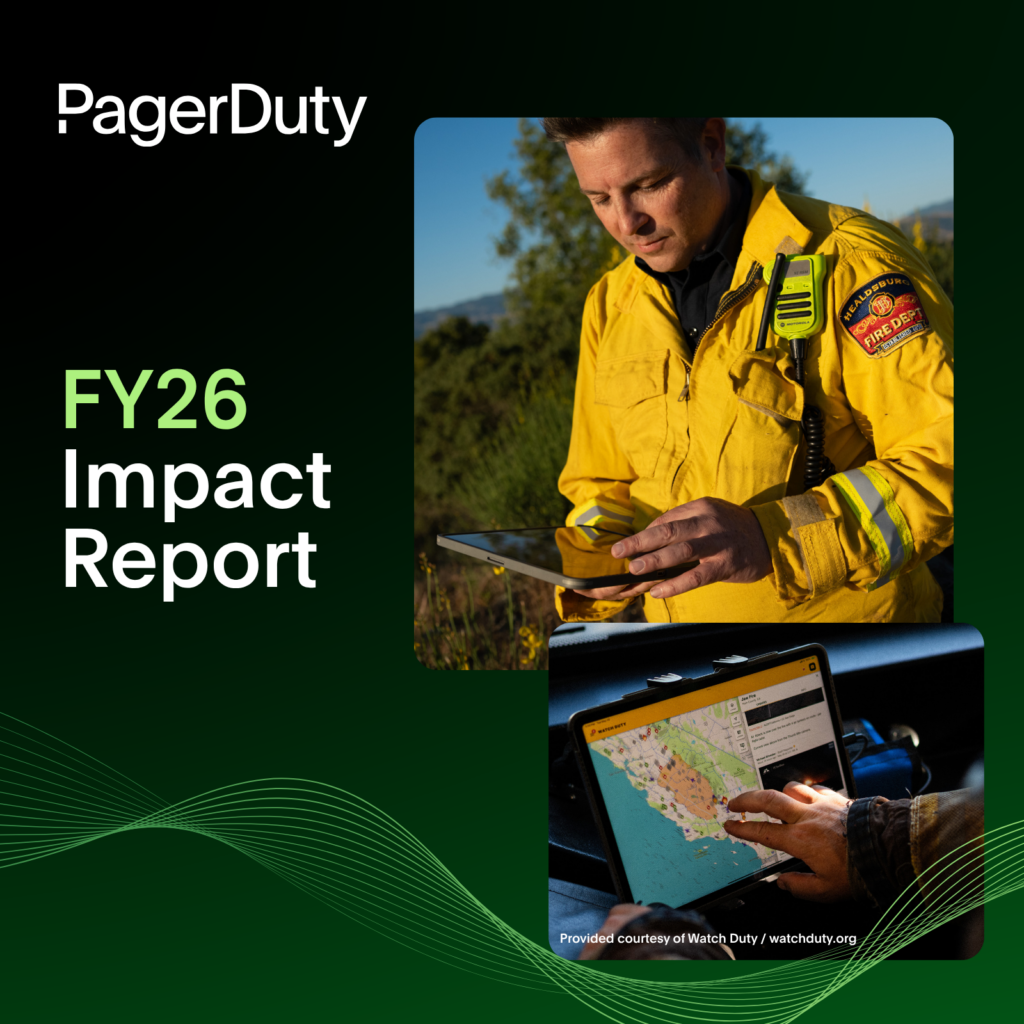
But technical infrastructure is only half the equation. PagerDuty bridges the gap between technology and people by supporting both the engineering and operations response teams simultaneously. At the core of Watch Duty is a deeply human operation consisting of 250 volunteers and 60 staff members who continuously gather, verify, and interpret data in real time. They monitor radio traffic, check cameras, track wind conditions, and distill complex, evolving situations into timely push notifications for end-users.
When fire activity spikes unpredictably and the slim dispatch crew needs additional capacity, PagerDuty acts as a vital mobilization tool to ensure that human scaling seamlessly matches technical demand. To boost coverage rapidly, Watch Duty leverages an alarm-style paging system via PagerDuty for roughly 30 backup reporters, enabling the organization to quickly mobilize backup staff when it’s needed most.
“It is especially helpful overnight and during high-risk windows like Red Flag Warning conditions, where a smaller number of people are covering a large footprint,” says Katlyn Cummings, Chief of Staff to the Chief Operating Officer at Watch Duty. “PagerDuty helps us call in support faster. If something starts moving too quickly or there is a gap in attention, PagerDuty gives us a reliable way to reach backup and primary on-calls immediately.”
Scaling Watch Duty’s Mission and Resilience
PagerDuty enables a relatively small, nimble team to operate with the same rigor, scale, and resilience as an enterprise-level corporation. Looking ahead, Watch Duty’s future plans are deeply rooted in its core mission: to provide true situational awareness and life-saving information during crises. As the organization looks to expand its footprint into broader natural disaster intelligence and emergency response operations over the next five years, maintaining integrity, accuracy, and community trust remains paramount.
According to Dave, “PagerDuty gives our growing team a reliable system for managing on-call duties and improving operations. As the need for real-time awareness of natural disasters increases, we’re confident PagerDuty will keep making our systems stronger and better able to handle the challenges that come with growth.”
As wildfire seasons grow longer and natural disasters become more severe, Watch Duty expects operational complexity and user demand to continue increasing. PagerDuty will remain a critical component of that growth strategy by helping reduce operational complexity while supporting resilient, scalable emergency response systems.
Watch Duty’s rapid evolution from a local, grassroots initiative to a nationally relied-upon emergency platform—now powered by an expanded network of hundreds of dedicated volunteers and staff—required a total transformation in operational reliability. By implementing PagerDuty as its foundational operational framework, Watch Duty has built a scalable system capable of protecting millions of users during the country’s most dangerous climate events.
For an organization where uptime directly impacts public safety, operational resilience is not simply an engineering objective—it is core to the mission itself.
–
PagerDuty is committed to supporting our nonprofit partners with technology and philanthropic investments through the PagerDuty Impact Fund. Learn how PagerDuty can automate, orchestrate, and accelerate urgent work at your mission-driven organization by starting a free trial today.